
CELPIP Reading Part 2 Practice Test: Reading to Apply a Diagram
A free Reading Part 2 practice set in the real CELPIP format, with answers and explanations. No sign-up: start below, and we score it in your browser.
- What it tests
- Using information from a diagram, such as a menu, schedule or map, together with a short email.
- Format
- A diagram and an email with 5 gaps, then 3 multiple-choice questions (8 questions).
- This practice set
- 8 questions. Instant score, CLB estimate and an explanation for every answer.
- Timing
- 9 minutes on test day. Here the timer starts with your first answer.
Start Reading Part 2
Read the passage and answer in the same screen layout as the test. Submit to see your score, an estimated CLB level and why each answer is right or wrong. Your answers stay on this device.
Read the following diagram.
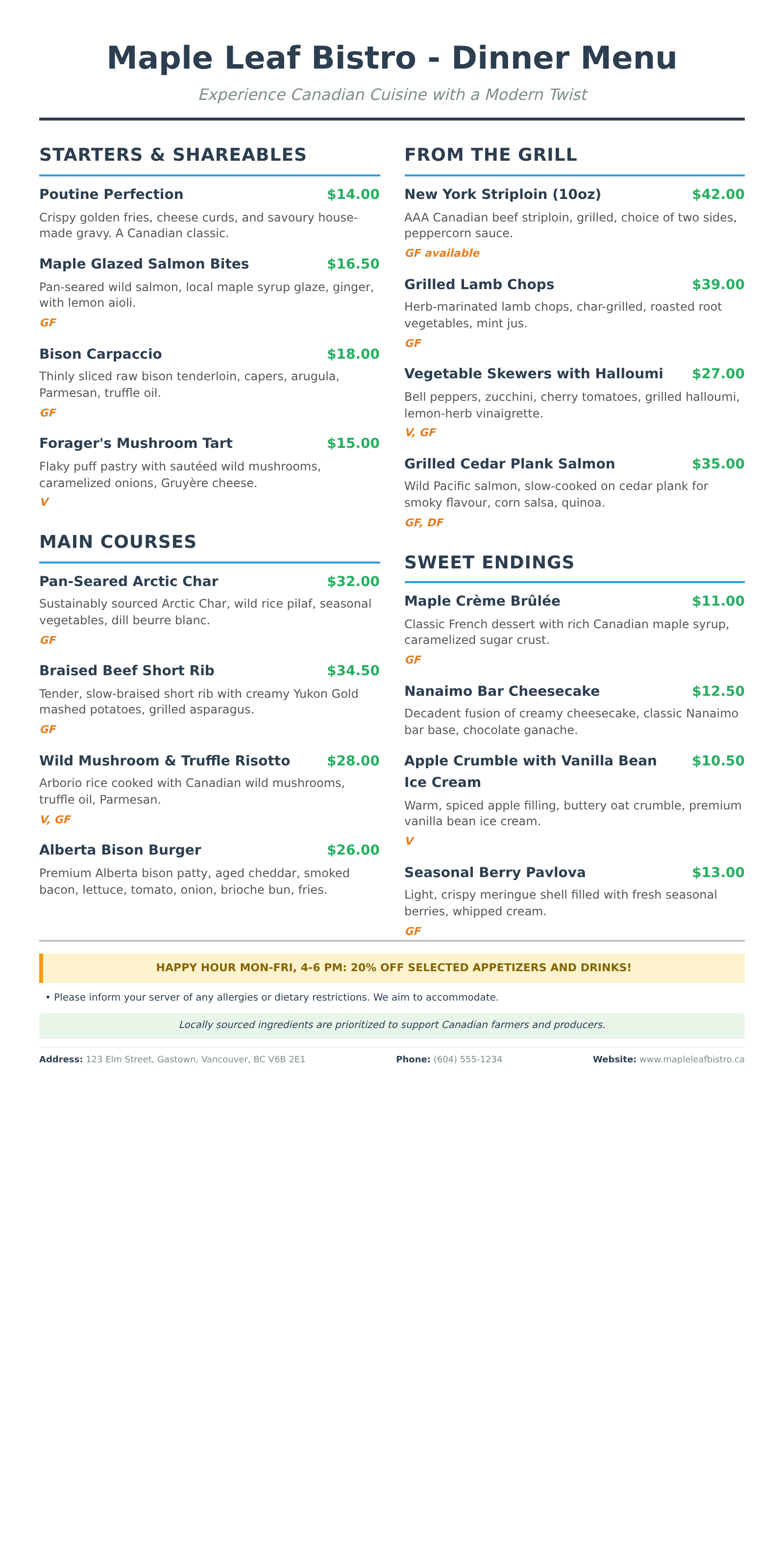
Read the email about the diagram on the left. Complete the email by choosing the best option for each blank from the drop-down menu (▼).
Using the drop-down menu (▼), choose the best option.
Part 2 answers and explanations
Blank 1
Answer: $14.00
Correct. The menu lists 'Poutine Perfection — $14.00'.
Blank 2
Answer: [V, GF]
Correct. The diagram states under 'Main Courses': 'Wild Mushroom & Truffle Risotto — $28.00 — Arborio rice cooked with Canadian wild mushrooms, truffle oil, Parmesan. [V, GF]'.
Blank 3
Answer: $42.00
Correct. The diagram states: "New York Striploin (10oz) — $42.00".
Blank 4
Answer: Decadent fusion
Correct. The diagram states for the Nanaimo Bar Cheesecake: 'Nanaimo Bar Cheesecake — Decadent fusion of creamy cheesecake...'. 'Decadent fusion' accurately describes a unique characteristic of it.
Blank 5
Answer: 4-6 PM
Correct. The 'Promo' section of the diagram under 'CONTACT & INFO' clearly states: 'Happy Hour Mon-Fri, 4-6 PM: 20% off selected appetizers and drinks!' This matches the blank for the exact time range.
Liam and Sarah are most likely
Answer: siblings
Correct. Liam mentions planning a 'surprise them with the anniversary dinner' for 'mom and dad,' strongly indicating he and Sarah are their children, hence siblings.
The main purpose of Liam's email is to
Answer: share dinner menu
Correct. Liam explicitly states, 'I just received the full dinner menu for the Maple Leaf Bistro, and I've attached it to this email...' and 'Let's go over it and pick out a few favourites'.
Liam's overall attitude towards the anniversary dinner is
Answer: excited and thoughtful
Correct. He expresses excitement ('I'm already imagining mom and dad's faces,' 'Can't wait!') and thoughtfulness by considering his parents' preferences ('mom might enjoy,' 'dad could go for') and dietary needs ('great for various dietary needs').
Read the email's need first
The email says what the writer wants. Then look up the matching detail in the diagram.
Check every condition
Gaps often depend on two facts at once, such as a price and a day. Confirm both before choosing.
Use the whole diagram
Small print, footnotes and banners on the diagram often hold the answer.
Practice questions, answered
What kind of diagram is in CELPIP Reading Part 2?+
It changes from test to test: a menu, a schedule, a floor plan, a price list or similar. You use it to fill gaps in an email and answer 3 questions.
How long do I have for CELPIP Reading Part 2?+
Nine minutes for 8 questions on test day.
Ready for the full test?
Each part here is one sample. The free full mock test has all 4 Reading parts (38 questions) plus Writing and Speaking, with a CLB score for every section.
These practice questions are our own original content, written to follow the CELPIP test format. They are not official test material. CELPIP is a registered trademark of its owner. We are not affiliated with Paragon Testing Enterprises or Prometric. The level shown after a single part is an estimate; a full test score depends on all parts.
Want the full method for every part? Read our CELPIP Reading strategies, or practise another set of all 4 parts on the CELPIP Reading practice test page.
More CELPIP Reading practice by part
- Reading Part 1: Reading Correspondence
- Part 2: Reading to Apply a Diagram (this page)
- Reading Part 3: Reading for Information
- Reading Part 4: Reading for Viewpoints